Seed Keeper (2025)
Designed by Laurel Green
For Digital Games and Learning at York University
Playtest: December 2025
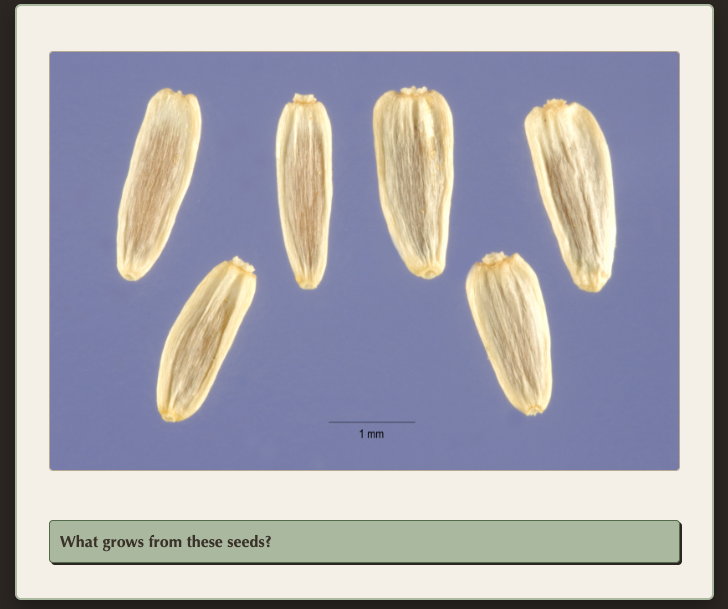
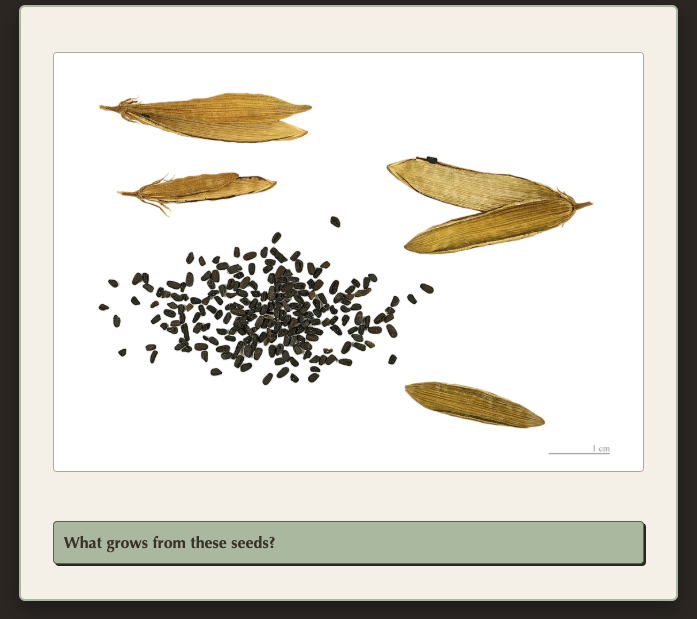
A Twine game exploring contemporary and ancestral relationships to native and invasive plant species found in my local ecosystem. Players examine a set of seeds, each one with a story to tell, and get a closer look at their behaviours and impacts before choosing which ones to plant.
Seed Keeper facilitates a set of close encounters between players and plant species with the goal to re-story and shift these relationships off-screen. The game empathetically builds awareness around issues like biodiversity loss, climate change, and the devastation caused by invasive and alien plant species, interspersing plant facts and provenance with custom illustrations and field interviews with naturalists, activists, backyard gardeners, artists, and bee stewards. Players must decide which plants belong and which are out of place, making choices about their garden that have impacts beyond their lifetime. By design, this experience challenges extractive, colonial gardening methods and de-centres the needs of humans.
While gardening video games replicate the experience of planting and tending a virtual garden, mainstream examples of this genre rarely include real-world information or descriptions of the risks and impacts of the seeds that you plant. There's little emphasis on native and invasive plant species, and whether the plant types are in or out of balance in a larger ecosystem.
Gardening Simulator as Critical Game
Garden simulators are often categorized as ‘cozy games’ which tend to prioritize relaxation and low-stress interactions with comforting aesthetics, open-ended goals, and simple mechanics. These games grant a player creative freedom and customization, providing a sense of accomplishment as they watch their gardens grow. Usually, these games feature fantastical made-up plant varietals and/or exotic species like fast-growing vines, succulents, lush ferns, and colourful blooms. Players are encouraged to make aesthetic choices (i.e. shape, colour) as to which seeds to select and where to plant, rather than making informed selections based on growing conditions, drought tolerance, climate, season, or habitat. This emphasis on gardens as neatly ordered sites of beauty reinforces a historically European and settler-colonial approach to gardening in which human desire is prioritized over the needs of the plants. In these games, plants are typically employed as in-game decoration and objects to be controlled by humans.
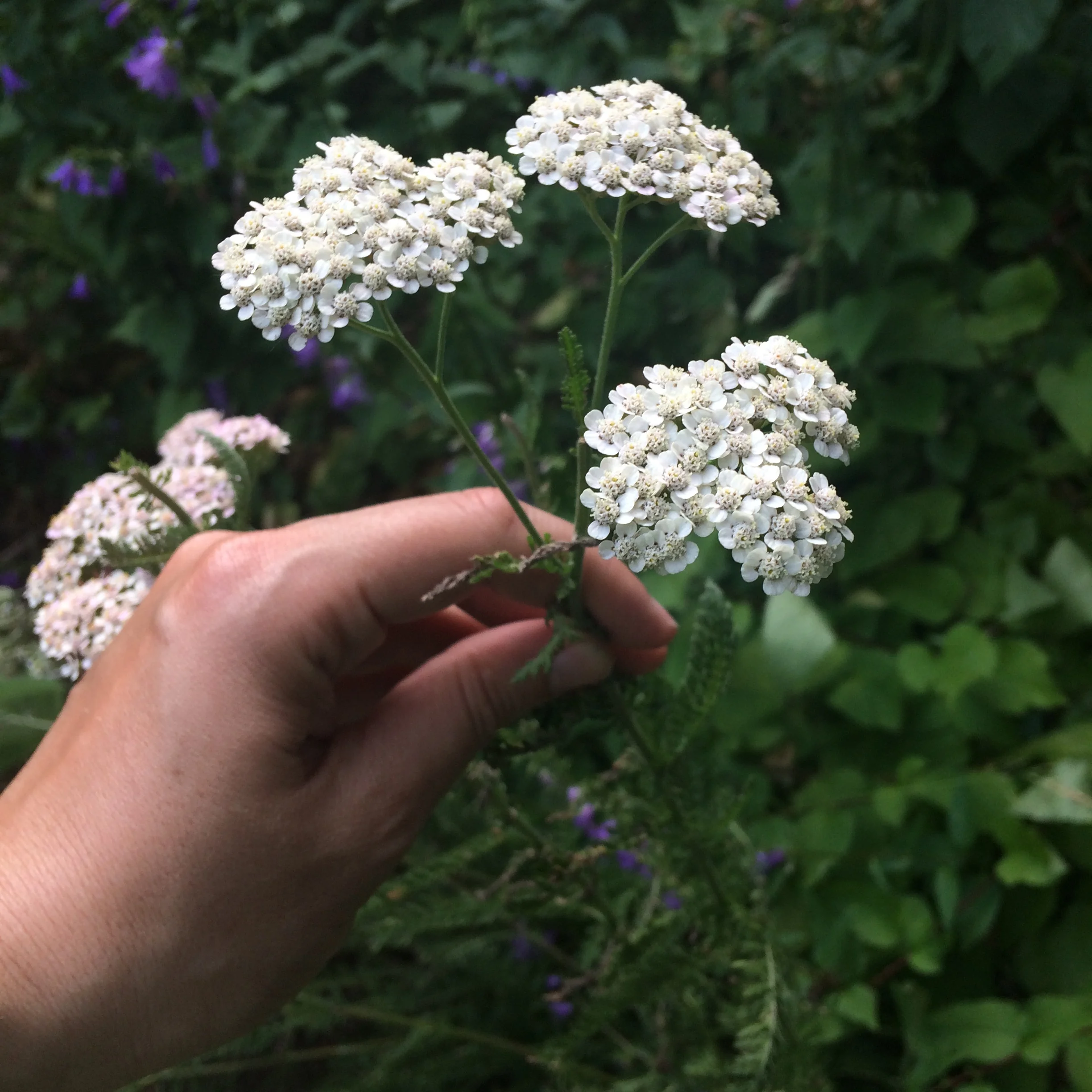
As players slow down to engage with digital gardening (for some, perhaps their first or only formative experience with plants) I see the opportunity for critical engagement, deep listening, and situated learning. The game will feature and make visible a series of common plants we typically see growing on roadsides, in parks, or find in un-tended areas across the country. The seed choices include pervasive invasive plant species that have become normalized through their ubiquitousness, and hardworking native pollinator plants often mistaken for weeds.
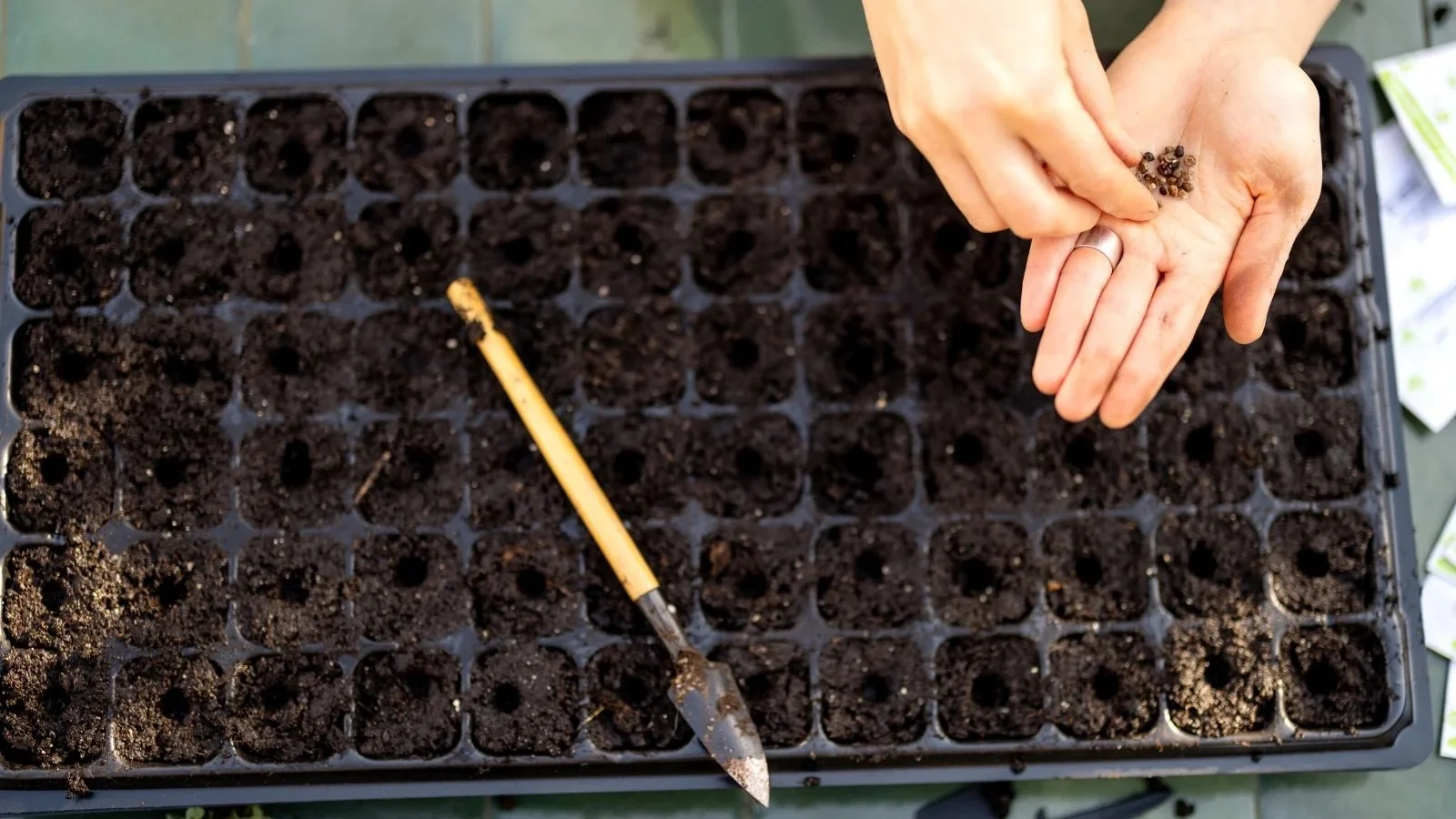
Rather than prioritize the garden’s growth or suggest that its bloom is a win condition, this game will linger in the seeding phase. Players must decide which plants belongs and which are out of balance, and then the game models the outcomes narratively over 5, 10, and 100 years.
-
1.1 Seeds / Plants (4 total)
Each seed is a discrete game object with:
seedSeen (boolean: true or false)
metBefore (boolean)
reflection (text string)
planted (boolean)
traits (pollinator value, resilience value, soil impact, invasive pressure)
explorationPaths (4 modules)
1.2 Player State
playerName
EcologyRegion
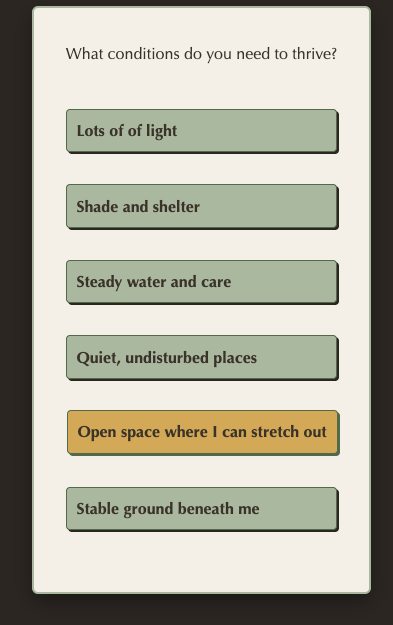
ThriveEnv (conditions to thrive)
ThriveGrowth (growth pattern)
attention (scalar)
reflectionFuture (text)
garden model scores:
pollinatorScore
resilienceScore
soilScore
invasivePressure
-
(repeated for each of 4 seeds)
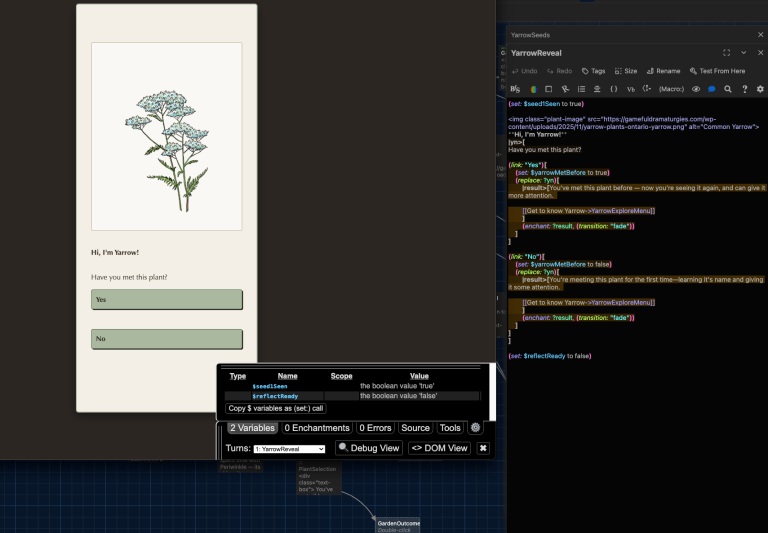
A1. Reveal
Set seedSeen = true.
Show plant image.
Ask: “Have you met this plant?”
Player choice sets metBefore = true/false.
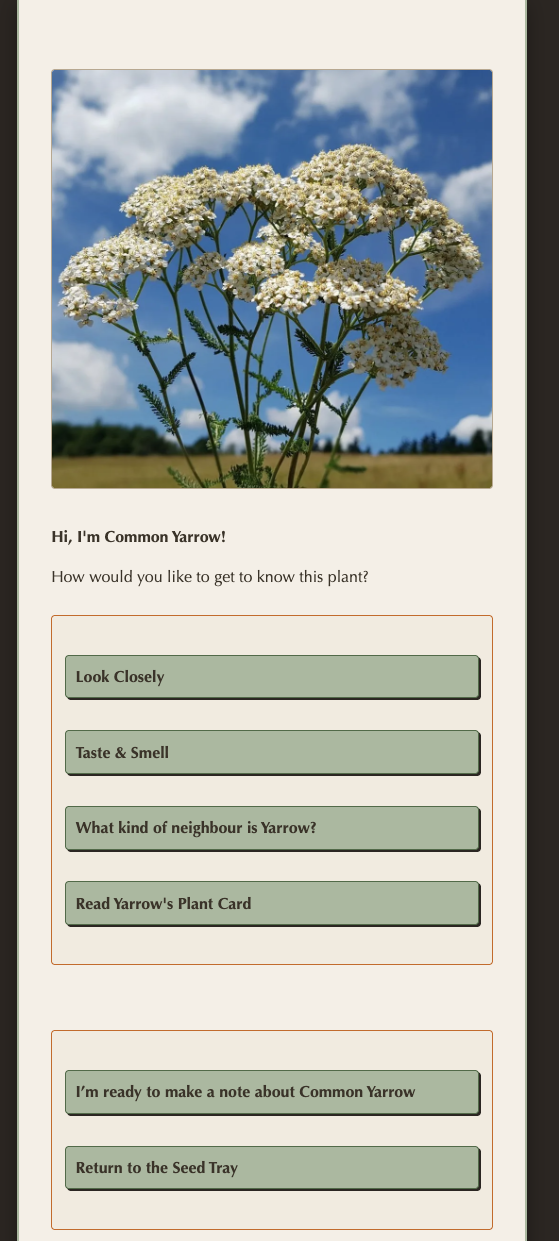
A2. Explore Menu
Player chooses among four exploration modules:
Look closely
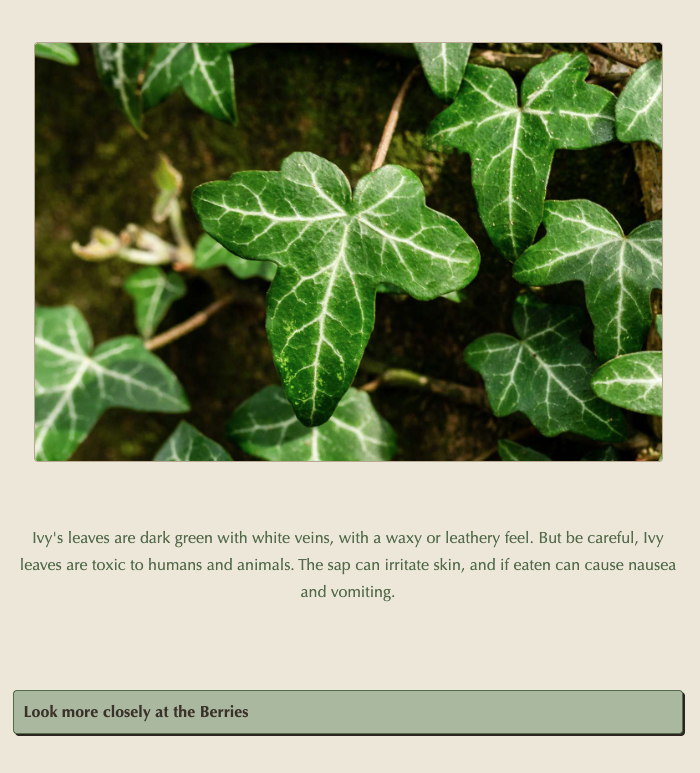
Click-to-reveal image sequence (wide → details: examine leaves, flowers)
Increments attention.
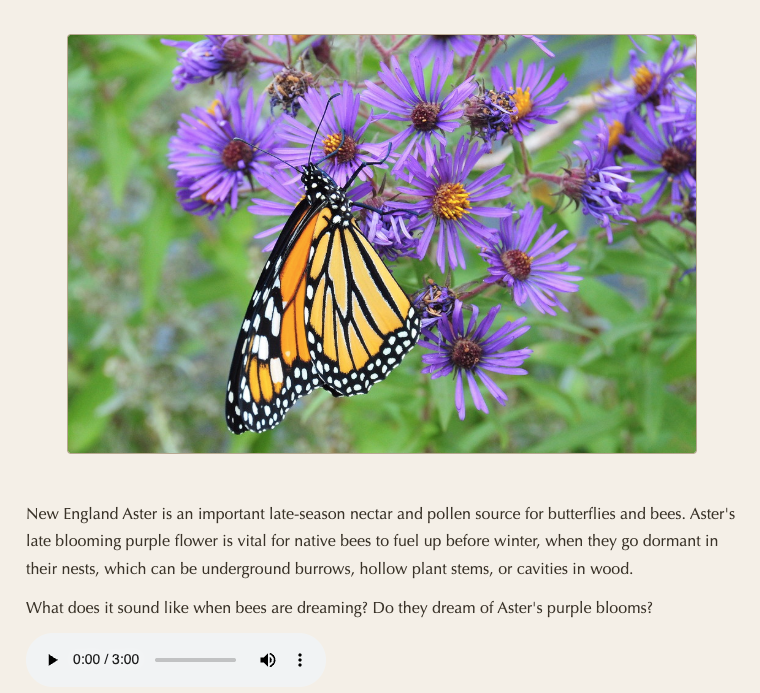
Listen
Audio clip: interview about relationship to plant.
Increments attention (optional).
Who visits this plant?(Pollinator module)
Teaches pollinator relationships.
Reinforces pollinatorScore logic.
Increments attention.
What kind of neighbour is it?(Behaviour module)
Teaches spreading, competition, ecological fit.
Reinforces resilience/soil/invasiveness logic.
Increments attention.
A3. Reflection
Optional note-taking:
Free-text saves into reflectionPlantX.
A4. Return to Tray
Seed tile switches from description → plant name.
Loop ends when all 4 seeds’ seedSeen = true.
-
Triggered once all seeds have been explored.
B1. PlantSelection Module
Player sees:
4 plant names
Their personal notes for each (optional reflection on what they’ve observed).
Player chooses any subset of seeds to plant.
B2. Scoring Application
For each planted seed:
pollinatorScore += plant.pollinatorValue
resilienceScore += plant.resilienceValue
soilScore += plant.soilValue
invasivePressure += plant.invasiveValue
planted = true
-
C1. Per-Plant Outcome Summary
For each of the 4 plants:
If planted = true → show ecological impact summary.
Show player’s personal reflection stored earlier.
C2. Garden Model Interpretation
Based on combined scores:
1-year outcome
Early effects of chosen plants (pollinator attraction, ground cover, invasive creep).
5-year outcome
Neighbour interactions, spread patterns, species diversity changes.
100-year outcome
Long-term ecological stability or degradation.
Scores are not shown numerically; they manifest as narrative messaging.
C3. Attention Reflection
If attention ≥ threshold: reflective acknowledgment of deep noticing.
Else: gentle encouragement toward slower noticing.
C4. Final Open Reflection
Player answers:
“What do you want to seed for the future?”
Stored in $reflectionFuture.
Game ends.
-
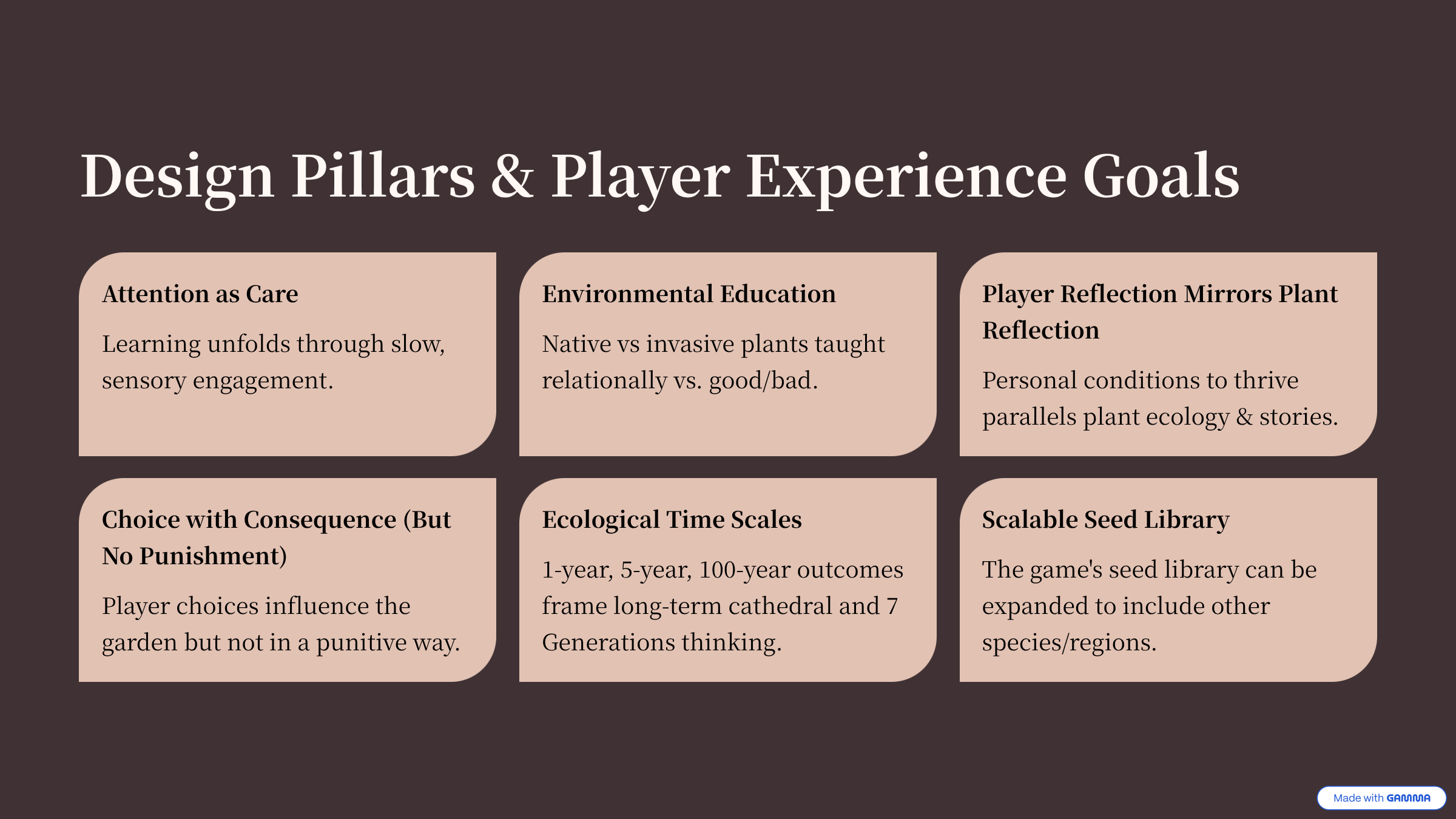
Mechanic: Reveal Gating
Seed names hidden until reveal.
PlantSelection locked until all seeds revealed.
Encourages exploration depth before decision.
Mechanic: Branching Exploration
4 modular knowledge paths per plant.
Supports multi-sensory + relational learning.
Does not alter scores → pedagogical, not gamified.
Mechanic: Reflection Capture
Player notes stored per plant.
Integrated into final summary.
Bridges affective and cognitive learning.
Mechanic: Choice-Driven Ecology Model
Planting choices → additive score model:
gardenHealth = f(pollinatorScore, resilienceScore, soilScore, invasivePressure)
Outcome narratives pull from score ranges, not exact values.
Mechanic: Player Self-Mirror
Early personal questions act as metaphorical scaffolding for plant traits.
Mechanic: Soft Unlocking
No timers.
No visible scoring.
No fail state.
Unlocks driven by attention and sequence completion.